A retention pond is a settling tank with grass around it. Runoff comes off roofs, parking lots and roads carrying sand, road salt, oil, tire grit and whatever washed off the landscaping. The pond slows the water down long enough for the solids to drop out before the clean water leaves through the outlet.
Which means the pond fills in. That is not a failure, it is the design working. The forebay, the small cell at the inlet, catches the bulk of it and fills the fastest.
The trouble starts when sediment eats into the volume the pond needs to hold a storm. Water leaves faster and dirtier, the permanent pool gets shallow enough to warm up and go anoxic, cattails and algae take over the shallow end, and eventually the pond stops meeting the numbers it was approved on. If its performance is a condition of your site plan agreement or your Environmental Compliance Approval, that becomes a compliance problem rather than a cosmetic one.
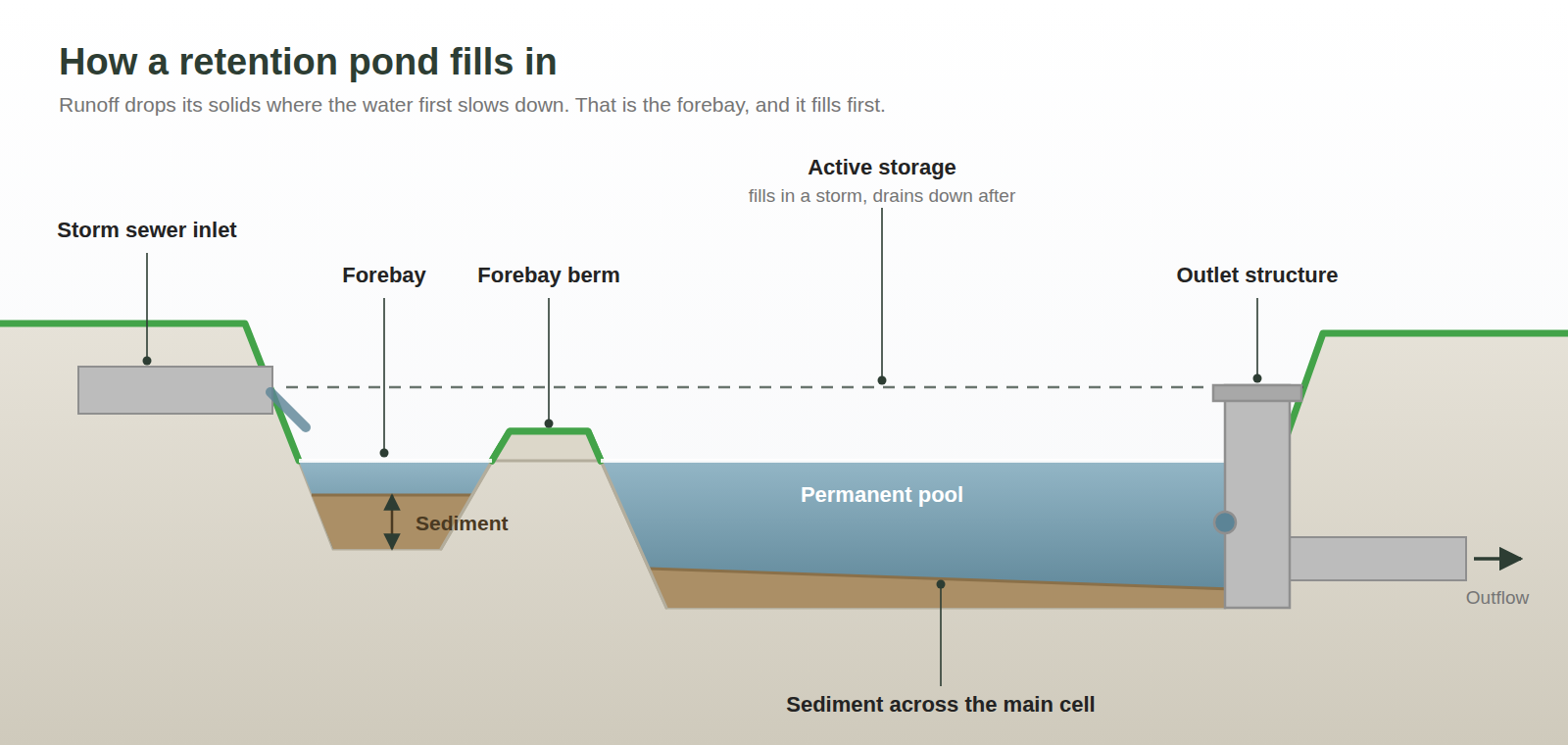
Ontario's stormwater design manual sets the cleanout point at the level of sediment that measurably cuts the pond's ability to remove suspended solids. For most ponds that lands somewhere between two and ten years, depending on how much storage the pond was given and how much hard surface drains into it.
For scale: the City of Barrie's two ponds scheduled for 2026 hold roughly 984 and 595 cubic metres of accumulated sediment. Barrie did four more in 2025. A pond that has never been touched since the subdivision or the plant was built is carrying numbers in that range.
Any two of those together and the pond is worth measuring. The measurement is cheap. Guessing is not.
The standard approach in this province is to dewater the pond, by gravity through the maintenance pipes or by pump, wait for it to dry enough to bear weight, walk a tracked excavator down the bank, dig, and then rebuild the bank and reseed everything the machine drove over. That is how the municipal projects are written up and it is what most contractors quote. It works. It also takes the pond out of service, tears up the site, upsets everyone whose window faces it, and adds a restoration bill on top of the removal bill.
We use low ground pressure amphibious equipment that floats. It works from the water, reaches the forebay and the shallow margins from the pond itself, and moves sediment to a dewatering area we set up on site. The banks stay intact. The pond keeps holding water. Residents and tenants keep their view of a pond rather than a pit.
That approach suits some ponds better than others. Where a full drain and dig genuinely is the right answer we will tell you, and we can work alongside an excavating contractor on the parts we are better suited to.
We measure sediment depth on a grid across the pond and compare it to the as-built drawings where you have them. That produces a volume in cubic metres rather than an estimate. Every number after this one depends on it.
Samples go to a lab. What comes back determines where the material is allowed to go, and that single answer moves the project cost more than anything else.
We confirm what permission the job needs before anyone mobilises, and tell you plainly what is yours to handle versus ours.
Before work starts, fish, turtles and amphibians in the work area are relocated to a safe part of the pond or nearby water, and the area is checked for nesting birds. Several of Ontario's turtle species carry protection, and this step is standard practice on municipal pond projects for good reason. It also affects when the work can happen.
Amphibious equipment works the pond. Sediment goes to a dewatering area on site, so the water drains back to the pond and only the solids leave the property.
Loads go to the destination the lab results allow, tracked and documented.
Bank repair where any was needed, plus a closing package: volume removed, lab results, tracking records, and photographs before and after. That package is what your engineer, your board or your municipality will ask for.
Pond sediment work in Ontario is usually done between July and September. That is the window municipalities schedule into, and the reason is ecological rather than practical: it avoids fish spawning and the bulk of the bird nesting season, and it is when water levels are typically at their lowest.
Which means the decision has to be made months earlier. Sampling, lab turnaround and any approvals sit ahead of mobilisation. A board that approves a cleanout in June is usually approving it for the following year.
If your pond is on a reserve fund schedule, the useful move is to get the sediment survey done now regardless of when the work happens. It converts a deferred line item into a real number, and it means the quote you take to the board is based on measurement rather than a guess.
Winter work is possible on the right site and sometimes works well, because frozen ground carries equipment without rutting and cold sediment handles and hauls better. It depends on ice conditions and on what the pond is doing that season. Worth asking about.
Most quotes for pond cleanout price the digging. The part that surprises owners is what the province requires you to do with the material once it is out of the water.
Ontario's On-Site and Excess Soil Management regulation, O. Reg. 406/19, applies. The province's own guidance is explicit that sediment cleaned out from stormwater management ponds is subject to the regulation, and that the exemption which covers some other soil does not apply to soil excavated from a stormwater pond for the purpose of maintaining it.
In practice that means sampling and analysis before the material moves, a soil characterisation report, a destination that has confirmed in writing it will take the material, and a tracking system accounting for every load. Projects above the volume thresholds also file a notice on the province's Excess Soil Registry before the first load leaves and update it within 30 days of finishing.
Clean sediment can often be reused, sometimes on the same property, which is the cheapest outcome available. Sediment carrying road salt residue, hydrocarbons or metals above the applicable standards has to go to a licensed facility, and the haulage and tipping fees on that are the single largest cost swing in the job. This is why the sampling happens before the quote is final, not after.
Work in or near a regulated area may need written permission under O. Reg. 41/24. Many conservation authorities treat routine maintenance of a stormwater facility as an exception where it does not affect flood or erosion control, but the policies differ between authorities and the exception is not automatic. We confirm it with yours rather than assuming.
If the pond sits under an Environmental Compliance Approval, or its performance is written into a site plan agreement or a subdivision agreement, the cleanout usually has to be documented in a way that satisfies those conditions. Tell us early and we will build the reporting to match.
One thing to be clear about: we are contractors, not your environmental consultant. For ponds under an ECA, or where sampling turns up something unexpected, you will want a qualified person involved. We will say so when that point arrives, and we work with consultants routinely.
Anyone who quotes a pond cleanout over the phone is guessing. Send these and you will get a number that holds:
If you have none of that, say so. It is common, and the site visit is how we build it.
A retention pond keeps a permanent pool of water year round. A detention pond drains down between storms and sits dry or nearly dry in between. Most people call both a retention pond. We clean out both, and the approach differs mainly in how we get equipment to the sediment.
Ontario's stormwater design manual bases the interval on the point where accumulated sediment measurably reduces the pond's ability to remove suspended solids. For most ponds that works out somewhere between two and ten years, driven by the pond's storage volume and how much paved area drains into it. The forebay fills much faster than the main cell, so cleaning the forebay on a schedule is usually cheaper over the long run than letting the whole pond fill and dredging it all at once.
No. Our amphibious equipment works from the water, so the pond stays wet and the banks stay intact. That is the main difference between us and a conventional excavating contractor, who will dewater the pond first. Some ponds are still better suited to a drain and dig, and we will tell you if yours is one of them.
Usually July to September. That window avoids fish spawning and most of the bird nesting season, and it is when water levels are lowest. Sampling, lab turnaround and approvals come first, so the decision needs to be made well ahead of the window. Winter work is possible on some sites.
It depends on the pond. Work in a conservation authority regulated area may need written permission under O. Reg. 41/24, though many authorities treat routine stormwater facility maintenance as an exception. Ponds under an Environmental Compliance Approval carry their own conditions. Separately, moving sediment off the property triggers the excess soil rules under O. Reg. 406/19 regardless of where the pond is. We work all of this out before mobilising and tell you which pieces are yours.
It gets dewatered on site so the water goes back to the pond and only solids leave. Where it goes after that is decided by the lab results. Clean material can often be reused, sometimes on the same site. Contaminated material goes to a licensed facility, with every load tracked.
They get relocated out of the work area before anything starts, and the area is checked for nesting birds. This is standard on municipal pond projects and it is part of why the summer window exists.
It scales with the volume of sediment, site access, and above all what the lab says about the material. Disposal of contaminated sediment can cost several times what clean material costs. That is why we measure and sample before quoting, rather than pricing off a walk around the pond.
Most single ponds run days rather than weeks once we are on site. The lead time before that is usually lab turnaround and approvals, so start earlier than you think you need to.
Working from the water is what avoids that. There is a dewatering area to set up and traffic to and from it, but the banks and the landscaping around the pond are left alone.
Weed Free Waters operates across southern and central Ontario from offices in Cambridge and Orillia. Retention pond work regularly takes us through Waterloo Region, Guelph and Wellington County, Simcoe County, Durham, York and Peel, along with the lakes and cottage regions we are better known for.
Not sure whether you are in range? Ask. We travel for the right project.
A sediment survey turns a deferred line item into a real number you can budget against. Send us the address and whatever paperwork you have, and we will tell you what the pond is holding.